Almost since the day it was written, Christians have debated the meaning of the biblical book commonly called Revelation. Most scholars believe it was written near the end of the first century by a Christian prophet named John who was living in exile on the island of Patmos. Addressed to seven small churches in Asia Minor, the book uses the highly symbolic language typical of Jewish and early Christian apocalyptic literature.
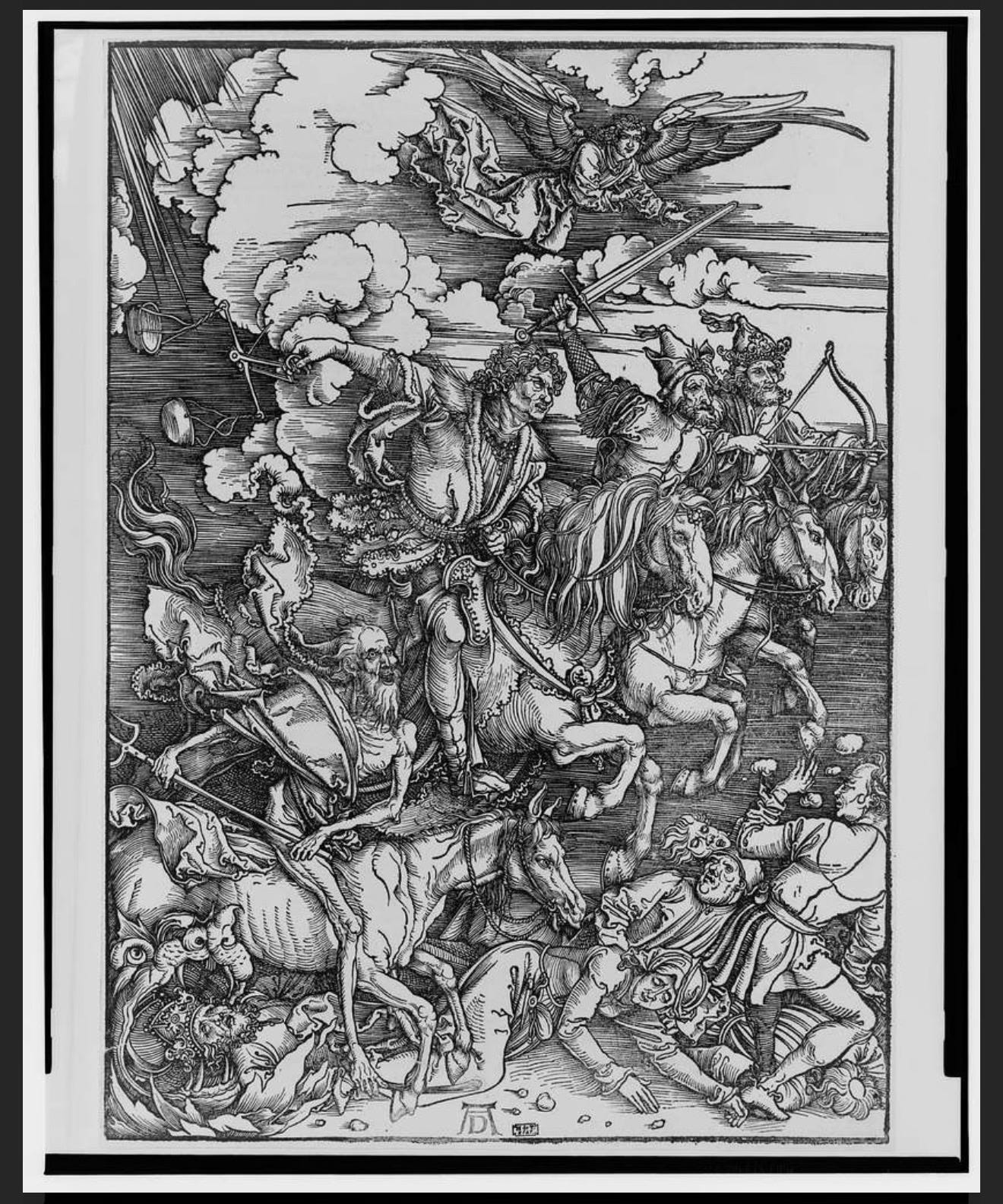
Apocalyptic writing relies on vivid imagery—beasts, angels, cosmic battles, and symbolic numbers—to communicate theological truths about God’s justice and the ultimate triumph of good over evil. Because of this symbolism, Revelation has always been difficult to interpret.
Throughout history, some readers have attempted to treat the book as a roadmap for predicting the exact timing of Christ’s return. These predictions have repeatedly failed. In the twentieth century Hal Lindsey’s The Late Great Planet Earth argued that the end of the world was imminent. Jerry Falwell suggested Christ might return around the year 2000. Even Isaac Newton attempted to calculate the date of the Second Coming, proposing the year 2060. Popular novels such as Tim LaHaye and Jerry Jenkins’ Left Behind series brought this style of interpretation into mainstream culture by imagining the rapture and a final global battle called Armageddon.
The Current Misuse
People are free to hold whatever religious views they wish. The difficulty arises when government officials begin presenting these interpretations as justification for public policy—especially war.
Since the beginning of the war in Iran, the Military Religious Freedom Foundation (MRFF) reports receiving more than 200 complaints from U.S. service members about religious rhetoric used by military leaders. According to these complaints, some commanders have described the conflict in explicitly biblical terms, framing it as part of the “end times” or even as a divinely ordained “holy war.”

One report described a combat unit commander telling troops that the conflict was “part of God’s divine plan,” and that President Trump had been “anointed by Jesus to light the signal fire in Iran to cause Armageddon and mark his return to Earth.” (“US troops were told war on Iran was ‘all part of God’s divine plan’, watchdog alleges,” The Guardian, March 8, 2026; Democracy Now!, March 9, 2026.)
If such statements are occurring in official military contexts, they raise serious concerns—both theological and constitutional.
Theological Concerns
The interpretation of current geopolitical events as steps toward Armageddon reflects a particular theological framework often associated with modern dispensationalist end-times theology. While influential in some evangelical circles, this approach is not the dominant view across global Christianity.
The majority of Christian traditions—including Catholic, Orthodox, and many Protestant theologians—have long rejected attempts to identify contemporary political events with specific prophetic timelines.
In fact, Jesus himself explicitly warned against such speculation. In the Gospel of Matthew he says:
“But about that day and hour no one knows, neither the angels of heaven, nor the Son, but only the Father.”
—Matthew 24:36
For most of Christian history, theologians have therefore urged humility when interpreting apocalyptic passages. Augustine, writing in the fifth century, cautioned believers against attempting to calculate the timing of the end. The purpose of apocalyptic texts, he argued, was not to provide a timetable for history but to encourage faithfulness and perseverance in difficult times.
When military leaders present modern wars as part of God’s apocalyptic plan, they move far beyond responsible interpretation of scripture.
Constitutional Concerns
Beyond theological disagreement, the use of apocalyptic religious rhetoric by government officials raises serious constitutional questions.
The Establishment Clause of the First Amendment prohibits the government from endorsing or promoting a particular religious belief. When officials acting in their official capacity present a war as the fulfillment of biblical prophecy, they risk crossing that constitutional line.

Such statements can create several problems:
• They promote a specific religious interpretation of scripture.
• They may pressure soldiers who hold different beliefs—or no religious belief at all.
• They occur within a rigid hierarchical structure where disagreement with superiors may feel professionally risky.
Courts have long been especially cautious about religious messaging within the military because of this power imbalance. Service members cannot easily walk away from their commanders.
Justice Stephen Breyer summarized the broader purpose of the religion clauses when he wrote that they were meant to “avoid religiously based social conflict” and preserve the separation of church and state (American Legion v. American Humanist Association, 139 S. Ct. 2067, 2090–91 (2019) (Breyer, J., concurring)).
When military leaders frame war as part of God’s plan for the end of the world, they risk entangling government power with sectarian belief in exactly the way the Constitution was designed to prevent.
The Moral Burden on Soldiers
Theological distortion in wartime rhetoric also affects the moral lives of the soldiers themselves.
From my own work with veterans, it is clear that military service already places extraordinary moral burdens on those who serve. Soldiers must reconcile their actions with their consciences, the laws of war, and their own ethical or religious commitments.
Professional military ethics therefore emphasize discipline, legality, and restraint rather than ideological zeal.

When leaders frame combat as participation in God’s end-times plan, they risk shifting soldiers’ moral framework away from duty and law toward a sense of sacred mission. That shift can be dangerous.
International humanitarian law—including the Geneva Conventions—depends on combatants recognizing the humanity of their enemies and maintaining limits even in extreme circumstances. Apocalyptic rhetoric, by contrast, tends to portray conflicts as absolute battles between good and evil in which ordinary restraints may appear irrelevant.
Recent comments from Secretary Hegseth only deepen these concerns. He reportedly stated: “We will keep pressing, we will keep pushing, keep advancing. No quarter, no mercy for our enemies.”
As reporter Matt Novak has noted, “no quarter” historically means refusing to take prisoners and instead killing enemy combatants outright. For more than a century, such declarations have been recognized as violations of the laws of war. Former U.S. government war-crimes lawyer Brian Finucane likewise observed that “[d]enial of quarter—even the declaration of no quarter—is a war crime.” (Heather Cox Richardson, Letters from an American, March 13, 2026.)
When apocalyptic religious rhetoric merges with language that dismisses legal restraints on warfare, the result is deeply troubling.
Why People of Faith Should Speak Up
Apocalyptic language has always exerted a strange fascination on human imagination. It promises certainty in uncertain times and cosmic meaning in the chaos of history.
But when that language migrates from the pulpit into the chain of command, it becomes dangerous.
The Constitution forbids the government from declaring a religious interpretation of world events. The Christian tradition warns believers against claiming to know God’s timetable. And military ethics insist that war must remain subject to law and restraint.
Apocalyptic rhetoric ignores all three.
Wars should never be fought in the name of prophecy. They should never be justified as steps toward Armageddon. And soldiers should never be told they are instruments of the end of the world.
The task before us is difficult enough: preserving a society where faith remains free, government remains accountable, and the terrible power of war remains constrained by law and conscience.
That task demands clear thinking—not end times mania.