

Anxiety is everywhere these days. Our national polarity makes us all less comfortable. There is uncertainty about our economy, our safety, and many of our national policies. Every news cycle brings new items to be worried about, and it is relentless.

The good news is that there are some things that we can do to alleviate this anxiety. One of the first techniques that I teach my patients is how to breathe in an intentional way.
The Sympathetic Nervous System
Our bodies have a sympathetic nervous system (SNS) that gets engaged when we get anxious. The SNS controls the body’s “fight-or-flight” response, the automatic reaction that prepares you to handle a threat or a stressor. The SNS increases our heart rate and blood pressure, and widens our pupils, making us ready to react quickly. This is really helpful if you are facing a bear or a thief, but less useful if you are worried about a presentation at work.
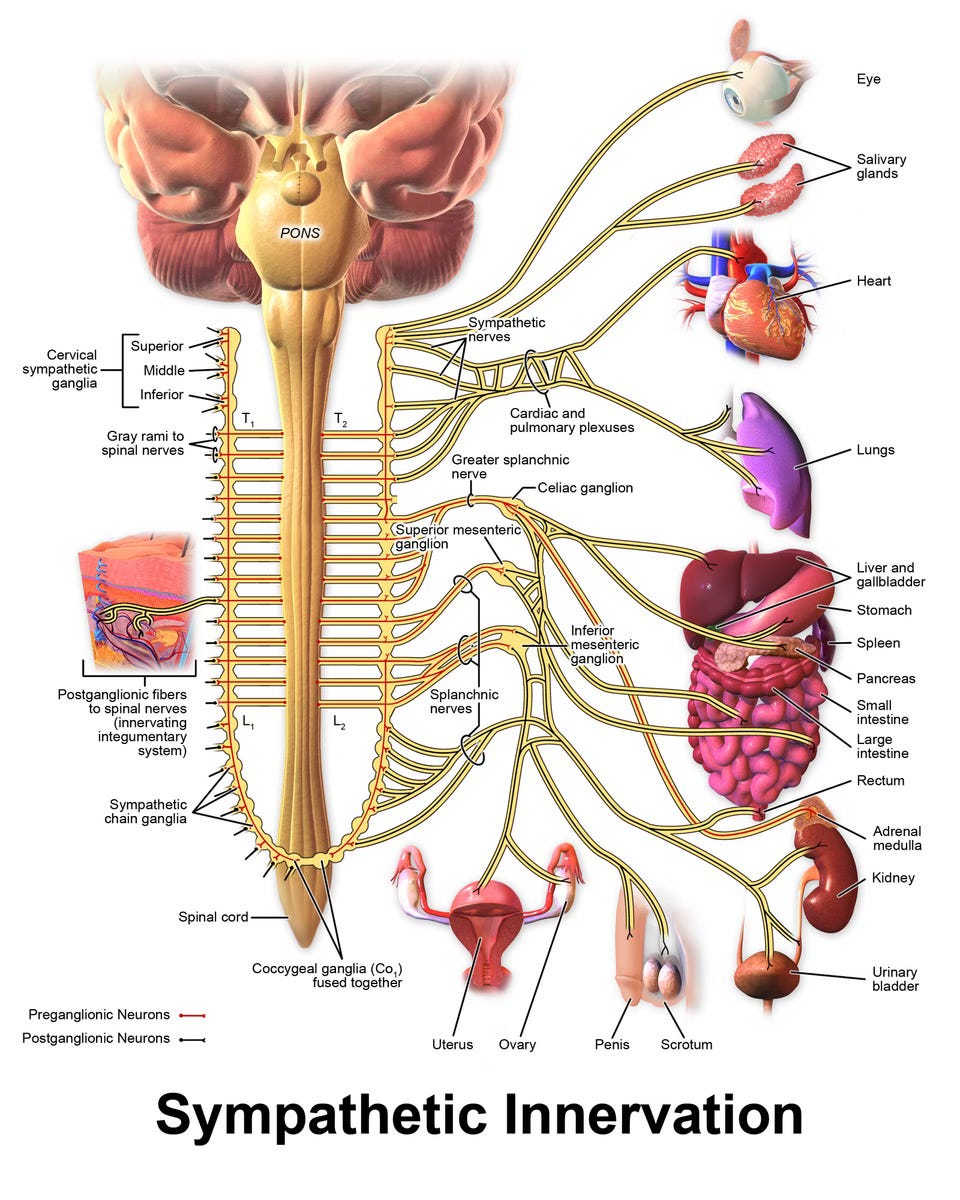
Say you are worried about that presentation. Your heart rate increases, you feel a pounding in your temples, and you feel tense. If you are prone to anxiety, this can begin a whole chain reaction. Your thoughts may begin to exaggerate your concerns, or you may even develop some concerns about things that are only remotely possible. David Spiegel, who is the director of the Center of Stress and Health at Stanford Medicine, says, “As soon as you notice what’s going on in your body, your brain thinks, ‘Oh no, this must be really bad,’ and you get more anxious. It’s like a snowball rolling downhill.” But using a breathing technique can help, Spiegel said. “When we teach people to control the physical effects of a stressor on their body, it puts them in a better position to deal with the stressor itself.”
The Parasympathetic Nervous System
In order to calm the SNS, we need to activate our relaxation system, called the parasympathetic nervous system. As you might guess, the parasympathetic system does the opposite of the SNS — heart rate slows, blood pressure is reduced, and our thoughts calm down. One great way to activate our parasympathetic nervous system is by breathing in a controlled way.
How to Breathe
There are many breathing techniques that work to help us relax, but I’ll focus on two: Diaphragmatic Breathing, and Deep Relaxation Breathing, sometimes called 4-7-8 breathing.
Diaphragmatic Breathing
Find a comfortable position, sitting or lying down.
Place one hand over your belly button.
Inhale through your nose and feel your belly rise. If you feel your chest rise more than your belly, you are not breathing deeply enough.
When you exhale, blow out through your mouth, with pursed lips as though you were blowing up a balloon.
Repeat this sequence for 5 minutes.

Deep Relaxation Breathing (4-7-8 breathing)
Find a comfortable position, sitting or lying down.
Breathe in through the nose for a count of four.
Hold your breath for a count of seven.
Exhale through pursed lips for a count of eight.
Repeat this sequence for 5 minutes.
Both of these techniques work to activate the parasympathetic nervous system.
These are tools that you always have with you — it costs nothing to give it a try. Take a breath!
For more information:
https://pmc.ncbi.nlm.nih.gov/articles/PMC10741869/
https://www.health.harvard.edu/blog/ease-anxiety-and-stress-take-a-belly-breather-201904261861
